This is part of The New Cost of Everything, a five-part series on what AI is actually changing — and what it isn’t. Each post stands alone. The argument compounds if you read all five. Start at Post 1 for the foundational framework.
Three paths companies are taking with AI and headcount — and why the choice should start with your own strategy, not the market’s
The AI workforce stories of the past two years seemingly follow a simple structure. Company announces AI investment. Company announces layoffs. Press release connects the two. If AI can do what those people did, the people are no longer needed. Right?
Sometimes that’s true. Sometimes the right answer is to do nothing at all — to hold the team you have, watch how the technology matures, and make a move when you know more. Sometimes it’s nuanced.
There are three real options on the table: cut and redeploy, cut and restructure, or cut and trust the technology to fill the gap. A fourth option — do nothing — gets less attention. But none of these is obviously correct. The right choice depends on the company’s vision, values, and an honest read of what’s actually blocking you. Sometimes a company picks an archetype before they’ve done the diagnosis. Sometimes they cut and then measure.
Three Companies, Three Different Bets
The best way to see the difference is through examples. Three companies, three structurally different approaches.
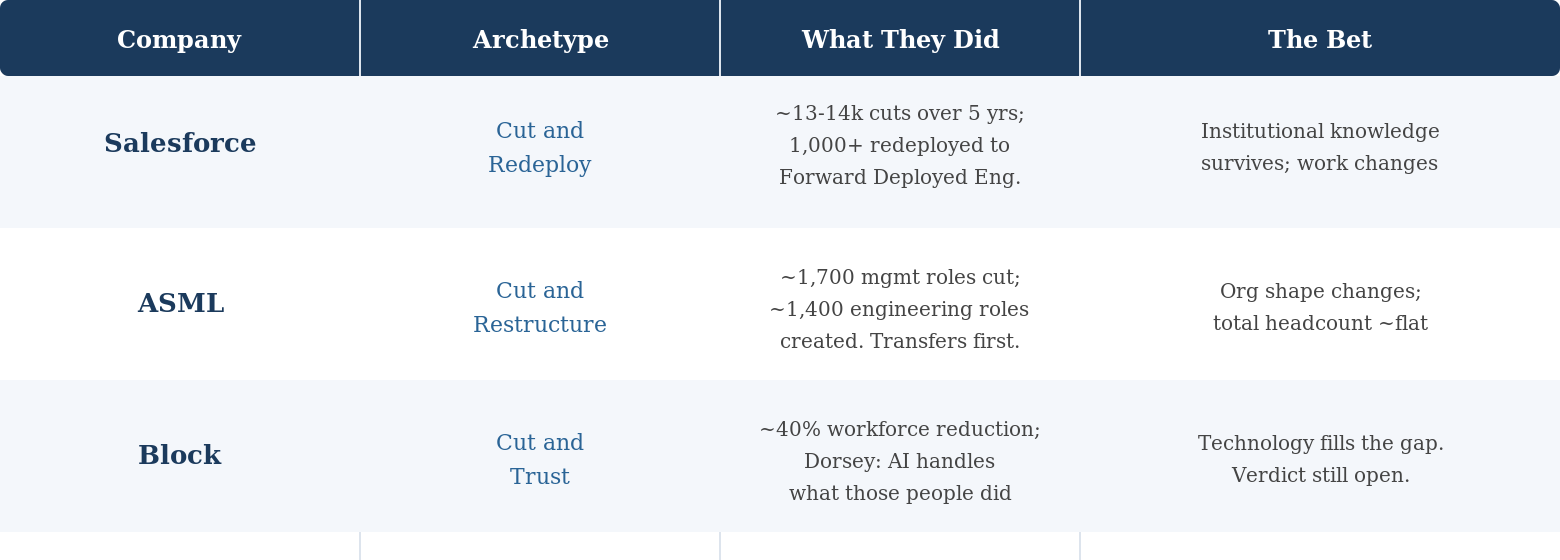
Salesforce: cut and redeploy. Over five years, Salesforce reduced headcount by an estimated 13,000 to 14,000 employees, including roughly 7,000 in early 2023 and approximately 4,000 to 5,000 in 2025.1 At the same time, the company built its Forward Deployed Engineering team to at least 1,000 people, redeploying support engineers into AI deployment roles through an internal talent marketplace called Career Connect. One executive described the process directly: “These are candidates who have deep Salesforce knowledge, understanding of AI, and are willing to lean into a new and meaningful space for the business.”
That’s not just a cut but a job description change at scale. It’s the popular FDE strategy. New role: AI deployment specialist embedded with customers, helping them actually use what they’re paying for. The institutional knowledge stays. The work changes.
ASML: cut and restructure. The Dutch semiconductor equipment company announced plans to cut approximately 1,700 management and administrative roles — department managers, scrum masters, project coordinators — while simultaneously creating about 1,400 new engineering positions focused on AI, manufacturing, and customer support.2 The stated rationale was direct: the management layer had created organizational complexity that was slowing engineering innovation. Internal transfers were prioritized before external hiring.
This is the most structurally honest version of the repositioning argument. ASML named what was slowing them down and removed it. They named what would move them forward and hired for it. The headcount numbers are almost identical. The organizational shape is entirely different.
Block: cut and trust. Jack Dorsey reduced Block’s workforce by roughly 40%, with the explicit claim that AI will handle what those people did. The bet is still live. There’s no verdict yet.3
Block is the most public example of a company choosing to cut and trust the technology to fill the gap, rather than repositioning people toward new work. Bold. The reasoning is internally consistent — if AI genuinely covers the function, the headcount is redundant. But the bet has a name, and the name is “the technology will be sufficient.” That’s a different claim than “we’ve figured out what we’re building next.”
A Framework for Reading the Decision
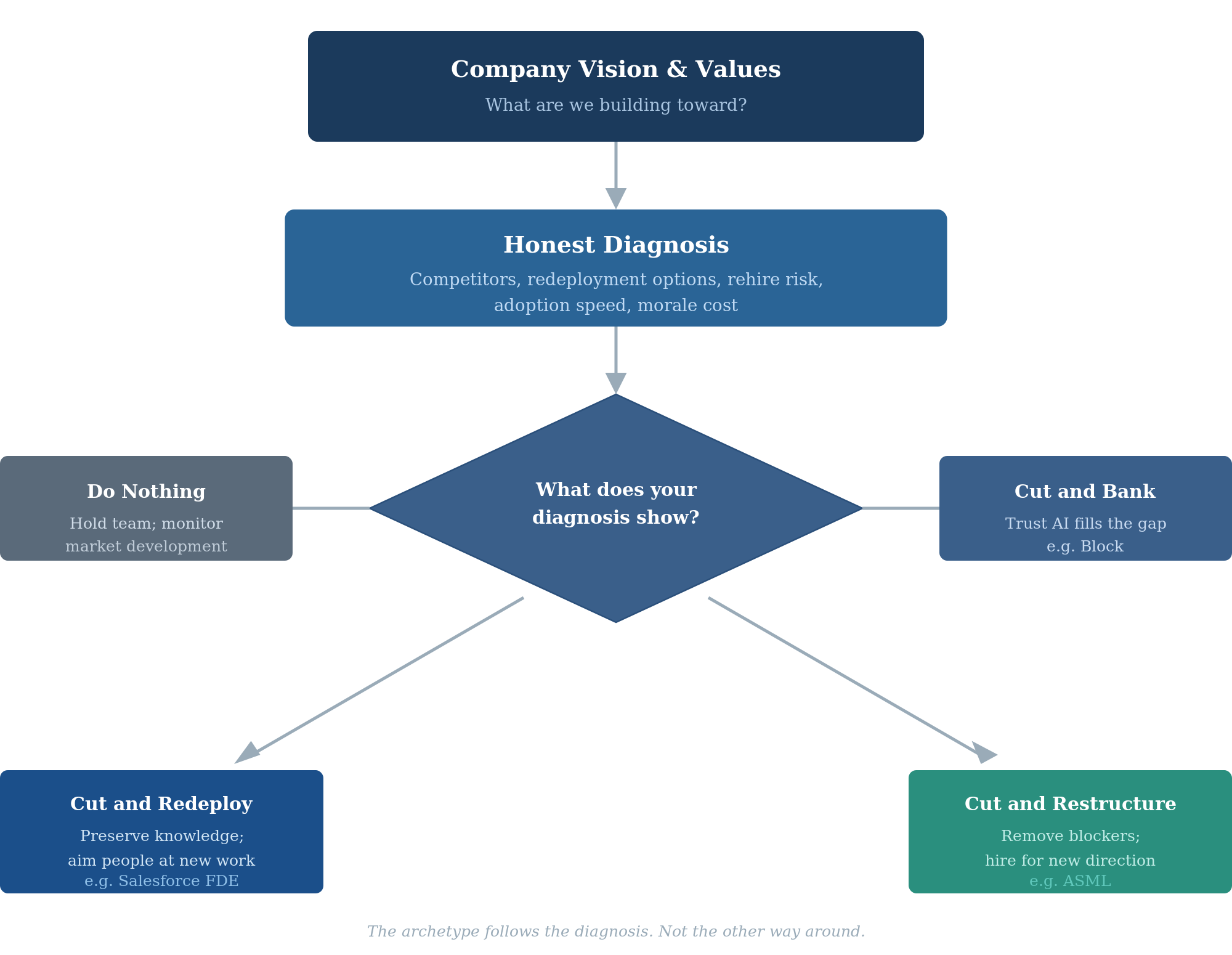
Four structural archetypes, based on what actually happens after the decision is made:
Cut and bank. Headcount down, savings captured. The explicit bet is that AI covers the gap. Block is the clearest public version. This can be correct. It’s also the easiest to execute and the hardest to verify until eighteen months later when either the gap is covered or it isn’t.
Cut and redeploy. Headcount reshapes rather than just shrinks. Existing knowledge gets aimed at new work. Salesforce’s FDE build is the example. This is harder to execute than cutting, because it requires having a destination for the people you’re moving. The destination has to be real — not a holding pattern with a new job title.
Cut and restructure. Remove what’s slowing you down. Hire what moves you forward. The composition changes even if the total doesn’t. ASML is the example. This requires the most clarity about what’s actually blocking you, which is why most companies don’t do it. It means naming the problem honestly.
Do nothing. This is also a choice. Some companies will look at the same landscape and decide their current team composition is the right bet — that their people will adapt, that the AI lift is sufficient, that the risk of disruption outweighs the cost savings. Do nothing can be correct. It can also be correct for the time being. It can also be the choice that looks obvious until it isn’t.
The Diagnosis Before the Decision
Richard Rumelt’s good strategy framework starts with a diagnosis before it arrives at any guiding policy or coherent actions. The same logic applies here. But before you run the diagnostic questions, you need something more fundamental: a clear answer to who your company is, what it is working toward, and what you believe about the people who build it.
A company that values deep customer relationships as a competitive moat reads the same AI landscape differently than a company competing on speed of deployment. A company that believes its people are its primary source of institutional knowledge makes a different bet than one that sees headcount primarily as a cost center. Neither value set is wrong. But the archetype a company chooses must be consistent with it. If the stated value says “our people are our greatest asset” and the workforce decision says otherwise, that isn’t a strategic choice. It’s a financial one dressed up as strategy.
Once you are clear on vision and values, run the diagnosis in this order:
- Customers. What do your customers need? What are their struggles, challenges, opportunities? How can they be better served either by you or your competitors?
- Competitors. If your competitors keep or expand their talent while you cut, what is your flywheel risk in 12 to 24 months? Can they build a better product, a richer customer experience, and deeper moats while you’re rebuilding after a talent reset?
- Redeployment assessment. Which of your current people can be moved into AI-adjacent strategic areas? Not as a holding pattern — as a real new function. If you can’t name the function, the redeployment isn’t ready.
- Rehire probability. What is the likelihood of needing to rehire these roles within 12 to 18 months? If the answer is more than 20%, the cut may be a short-term gain against a long-term cost. Companies that move too fast often end up quietly rehiring, hurting morale and productivity.
- Adoption speed. What is the risk to internal productivity if you reduce headcount faster than AI capability can absorb the work? Speed of adoption matters as much as availability of tools.
- Morale cost. What risk does the cut create for the team that remains? A demoralized team doesn’t execute well on AI adoption, which is exactly the capability you need them to build.
These questions don’t lead to a universal answer. A company with high technical debt and a clear AI roadmap has a different diagnosis than a company with deep customer relationships and an uncertain product direction. The framework is only useful if the diagnosis is honest — and the diagnosis is only useful if it’s grounded in a vision you’ve actually committed to.
Asymmetric Effects
AI is not affecting all roles equally. Administrative roles, data entry, routine content generation, first-level support — these are genuinely being replaced in many cases. The economics are clear, the task structures are well-suited to current AI capabilities, and the replacement is often cleaner than the repositioning alternative.
Engineers, developers, and product leaders who can direct AI agents, evaluate AI-generated output, and move into the work of the greenfield tier are exactly the people you shouldn’t cut. Not because AI can’t assist them. Because they’re your gateway to the greenfield goals, and those goals aren’t yet defined. That’s exactly why you need the people capable of defining them.
A company that cuts its engineering capacity in the name of AI efficiency has made a bet that it already knows what it’s building.
Questions to Answer Before Cutting
“Measure twice, cut once” is a construction cliche for very good reasons. The test isn’t whether AI can do the work. For a growing number of functions, it can. The test is whether you’ve answered what you’re building toward and whether the workforce decision is consistent with that answer.
Start with vision. What does winning look like for your company in three years, and what kind of organization gets you there? Then run the diagnosis honestly: what’s slowing you down, what capabilities do you need that you don’t have, and what’s the actual risk of moving too fast versus not fast enough?
The archetype — cut and bank, cut and redeploy, cut and restructure, or do nothing — should emerge from that work. If you picked the archetype first and the vision second, that’s a budget decision you later justified.
The companies that get this right will look different from each other. That’s the point. There’s no one correct answer. But there is a correct sequence: vision first, diagnosis second, decision third.
Next in this series: The Cost of Cheap Code — When shipping becomes nearly free, the constraint moves. It’s no longer “can we build it?” It’s “can our customers absorb it?” The pace of AI product releases isn’t a feature. For most users, it’s a tax.
Notes
-
- Salesforce headcount reductions of approximately 7,000 in January 2023 and approximately 4,000–5,000 in early 2025 were reported by Reuters, Bloomberg, and the Wall Street Journal. The Forward Deployed Engineering team and Career Connect internal marketplace were described in company blog posts and executive interviews published in 2024 and 2025. ↩
- ASML announced the restructuring in late 2024. Reporting via Reuters and the Financial Times. The internal transfer policy was stated in company communications at the time of the announcement. ↩
- Block workforce reductions were announced across multiple tranches in 2024 and 2025. Dorsey’s rationale was stated directly in internal communications that were reported publicly. The outcome remains unverified as of this writing. ↩
 Jeff Beaumont