This is part of The New Cost of Everything, a five-part series on what AI is actually changing — and what it isn’t. 1
I spend a lot of time reading about and talking to people about AI. Most of those conversations follow the same arc. Someone describes a tool they’ve started using. They tell me how much faster it is. Often they mention the quality is better, too. And then the conversation ends, as if faster and better are the whole story.
Then there’s the third thing, and it’s the most important one. Invigorating, too.
It’s hard to imagine what does not exist. Companies can optimize for efficiency or effectiveness while incapable of calculating what does not yet exist.
The Three Tiers
The first tier is efficiency. AI does existing work faster. You draft emails in two minutes instead of fifteen. Summaries that used to take an afternoon happen in seconds. The work is the same; the time is different. This is real value, and most organizations are capturing some of it.
The second tier is effectiveness. AI does existing work better. The analysis is tighter. The copy is stronger. The research covers more ground. This is harder to measure but more durable. Organizations that get to tier two don’t just move faster; they raise their baseline output quality.
The third tier is greenfield. This is work that couldn’t have been done at all. Not work that was slow or mediocre. Work that was off the table. Structurally impossible given your budget, your team size, your timeline, or your available expertise. AI doesn’t make this work faster or better. It makes it possible.
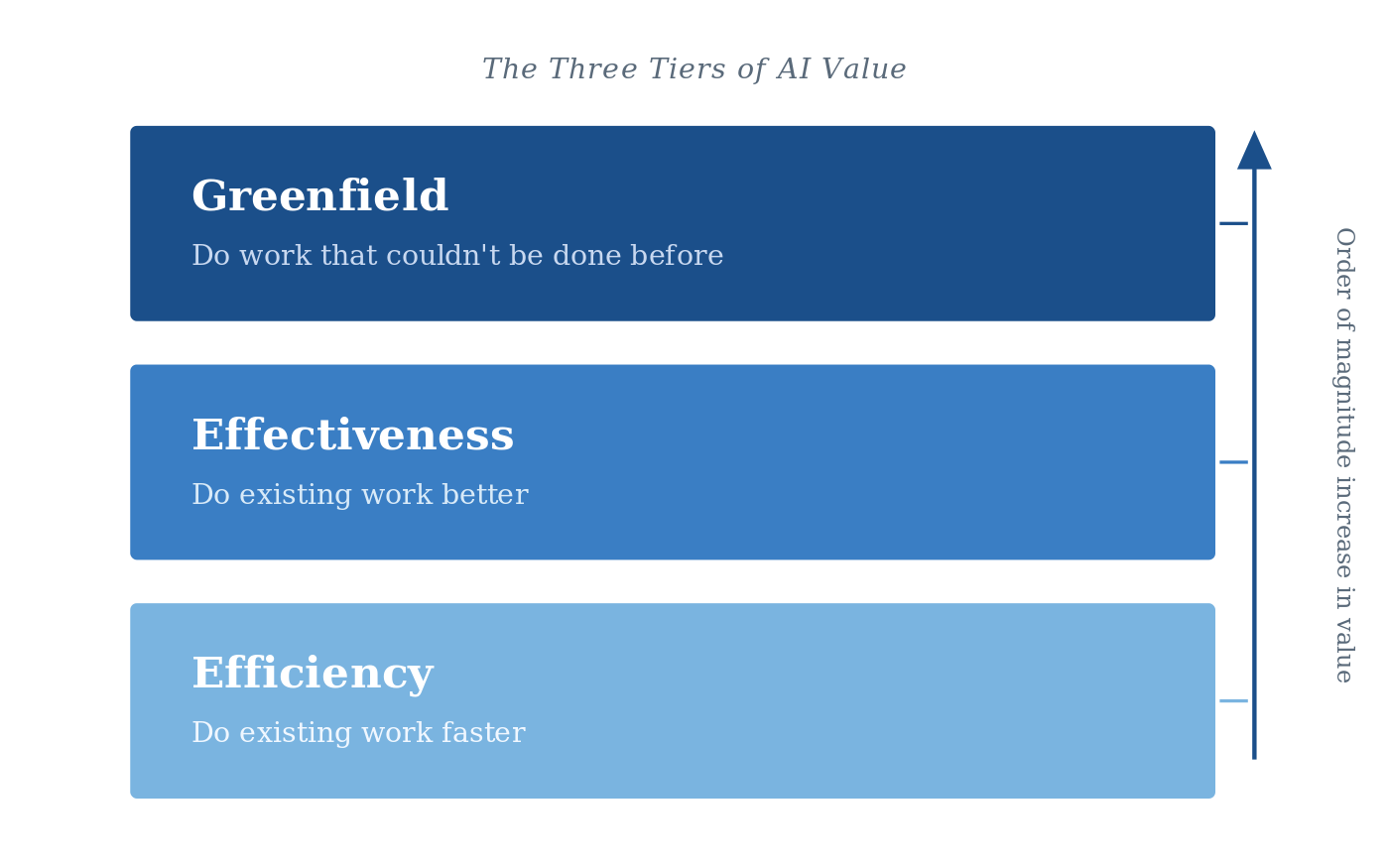
Most AI conversations live entirely in tiers one and two. That’s where the obvious wins are, and they’re real wins. We can see and verbalize it. But the greenfield tier is where value creation happens at a different order of magnitude. This is where companies will truly differentiate from others.
A fair objection: isn’t greenfield work just efficiency at an extreme scale? No, and the distinction matters. Efficiency compresses time on work you were already doing. Even at its most extreme, a ten-minute task becoming ten seconds, you’re still on the same track. Greenfield changes the track. The economic impact analysis I ran at Mercy Ships wasn’t a faster version of something we were already doing. There was no slower version. The track didn’t exist.
Two Examples From Where I Sit
I lead a finance team on a hospital ship off the coast of West Africa. We are volunteers, operating on a nonprofit budget, with no internal engineering resources. I want to be specific about that context, because it matters for what follows.
A few months ago, we needed to understand the economic impact of our work in the region. This was not a new problem. We knew the question was worth answering. What we didn’t have was the analytical horsepower to do it rigorously: the kind of multi-variable study that would normally require a team of analysts, weeks of structured research, and expertise we didn’t have on staff. Even if we wanted, we couldn’t simply borrow a framework from someone else because we didn’t know where to start.
With AI, I ran the analysis myself in an afternoon. Not a simplified version. A rigorous one to map money brought into the country, from multiple accounting sources, and created cost-benefit analyses, structuring the model from scratch. The work was not faster than the old approach. It replaced a project that had no realistic execution path. That’s greenfield.
A second example, more recent. We needed a way to track shipping containers. For a land-based company, this is a solved problem: there are tools for it. For living in West Africa with shipping containers coming from two different locations, delays, and mis-directed shipments, it’s a project that stays on the ideas list indefinitely. With AI tooling, I built a functional tracker in a few hours. Not a perfect one. But a working one. The concept existed before I built it; the capability to build it did not. It not only saves time, but gives insight into what is happening in real time.
Both of these feel small in isolation. They’re not. The pattern they represent is the argument.
How this applies beyond nonprofit operations
The constraint that made these projects impossible for us — no engineering staff, no implementation budget, no analytical team — is the same constraint that shelves projects at well-funded tech companies. It just looks different: “we don’t have bandwidth,” “it’s not in the roadmap,” “the ROI doesn’t clear our hurdle rate.” The greenfield tier isn’t unique to resource-constrained environments. It’s where every organization leaves value on the table.
A Corporate Proof Case
A 120-person precision manufacturing company in Ohio needed to qualify for zero-defect aerospace contracts. The problem wasn’t capability: their people could do the work. The problem was inspection. Meeting aerospace standards required AI-powered vision inspection and predictive maintenance infrastructure that a company their size had no realistic path to building. Traditional enterprise implementation was quoted at roughly $2.8 million. The project was structurally out of reach.2
They deployed an AI-based system in eight weeks for approximately $85,000 and qualified for the contracts.
The important word in that story is qualified. Not “did their existing work faster.” Not “improved their defect rate.” They entered a market they were previously excluded from. The aerospace contracts weren’t on a slower track before AI. They weren’t on any track. That’s the distinction the first two tiers can’t explain.
Where the Framework Comes From
The three-tier model is my applied synthesis, but it rests on work that predates my framing of it.3
Agrawal, Gans, and Goldfarb mapped AI’s economic role through the lens of prediction in Prediction Machines: The Simple Economics of Artificial Intelligence (2018): their argument being that AI dramatically lowers the cost of prediction, which in turn changes how we make decisions and which tasks are worth automating. The prediction layer feeds into judgment, which feeds into action. The action layer, agentic AI that takes autonomous steps in the world rather than just generating output for a human to evaluate, is where the greenfield tier arrives at scale.
We are early in that agentic layer. Which is exactly why now is the time to be asking what’s in your parking lot. What are a few things you’ve always wanted but knew you could never pursue?
The Honest Question
Most organizations have lists of projects that were deemed too expensive, too complex, or too resource-intensive to pursue. Some of those decisions were right. Some of them were right at the time but aren’t anymore. And some of them, the most interesting ones, were never really about cost or complexity. They were about the project not having a realistic execution path given existing constraints.
The greenfield tier changes the execution path question. Not for every project. Not without real effort and judgment. But for more projects than most organizations are currently testing.
The question worth asking isn’t “how do we use AI to do our existing work better?” That question leads you to tier one and tier two returns, which are real but finite. A better question is: what could we attempt now that we couldn’t attempt before? An even better one is: in line with our mission, what should we pursue given the tumultuous economic changes, what our customers need, and what we have to offer?
Pull your parking lot. Some of what’s in there is still a bad idea. But not all of it.
Next in this series: The Hurdle Rate Has Dropped — AI doesn’t lower your cost of capital. It lowers your effective hurdle rate by collapsing the cost of execution. The math behind what belongs back on your roadmap.
Notes
- This is part of The New Cost of Everything, a five-part series. Post 2 extends this framework into capital budgeting. Post 3 applies it to workforce restructuring decisions. Post 4 examines what happens when the greenfield tier ships too fast for customers to absorb. Post 5 traces the historical pattern: bundling always follows a cost collapse. ↩
- Case reported by Manufacturing Accelerator. Company not named in the source. The cost figures ($2.8M traditional implementation, $85K AI deployment, eight-week timeline) are as reported. The proof point is the structural shift — from impossible to accessible — not the specific numbers. See: How Growing Companies Are Using AI to Compete Against Fortune 500s. ↩
- Agrawal, Gans & Goldfarb, Prediction Machines: The Simple Economics of Artificial Intelligence (2018). The framework maps AI capabilities across prediction, judgment, action, and data. The agentic tier, AI that takes autonomous action rather than just providing output, is where the greenfield tier materializes at scale. ↩

