Key distinction: The gap between knowing AI is coming and strategizing for it. We had the roadmap; the risk was not being able to connect the dots.
We Had the Roadmap. We Just Didn’t Use It.
In 2016, Ajay Agrawal and co-authors published a piece in HBR called The Simple Economics of Machine Intelligence. The core argument was almost disarmingly simple: as the cost of prediction drops, prediction gets used everywhere — including in places we haven’t imagined yet. Autonomous vehicles weren’t magic. They were the predictable result of data becoming cheap enough to enable judgment at scale (bad pun, I know).
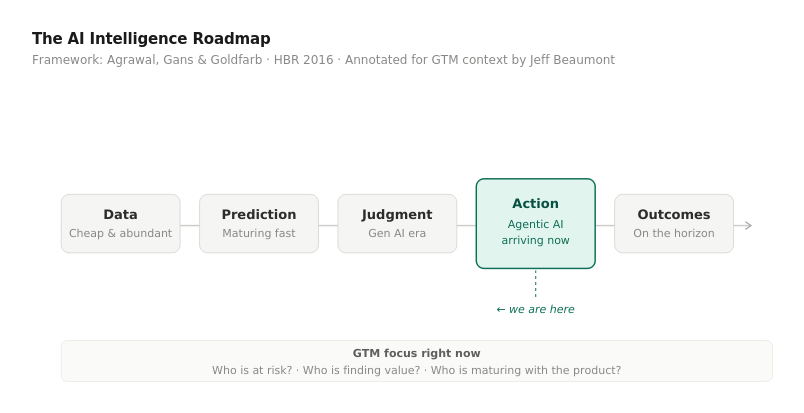
I wrote about that framework in 2018 through a Customer Success lens. The five components — data, prediction, judgment, action, outcomes — were already mapped out. The trajectory was visible.
And yet most companies, including ones I’ve worked inside, treated the arrival of generative AI like a weather event: something that happened to them, not something they could have seen coming. It is, in a sense, not being in control.
The current moment is not the surprise. The current moment is the bill coming due for not taking the roadmap seriously.
Here’s what the roadmap says about where we are now: predictive AI is maturing, generative AI is being absorbed, and agentic AI is the next phase — systems that don’t just tell you what to do but go do it and report back. For go-to-market specifically, that means we’re largely still in the prediction and judgment stage: who is at risk? who is finding value? who is actually maturing with the product? The action and outcome phase — AI that executes the intervention, not just recommends it — is closing in. In-app guidance, automated workflow execution, agentic task completion inside the product itself. The rough form, version 1, is already here.
The question isn’t whether this is coming. We agree it is. It’s whether we are building toward it or waiting to react again.
Clorox — a bleach company — embedded generative AI into core innovation workflows and cut their discovery cycle time in half. If Clorox can do it, the constraint isn’t technology or cost. It’s decision-making, company buy-in, and executive leadership. And the irony is sharp: the very thing AI promises to help us do better — make faster, clearer decisions under uncertainty — is exactly what’s stalling our adoption of it.
The risk isn’t that AI moves too fast. It’s that we’ve been surprised by something we had every reason to see coming. Ajay wrote the book on this. Go read it before we’re caught reacting again.
 Jeff Beaumont
One thought on “Predicting AI Was Not the Problem. Preparing for It Was.”