“We have too many VPs acting like directors — they are overpaid and ineffective for what they produce.”
Someone said that to me early in my career. It landed hard. Not because it was harsh, but because I could picture exactly who they meant.
The VP role is genuinely ambiguous. Most people who get promoted into it earned the promotion by being exceptional at doing. They built things, fixed things, ran things well. And then they get the title and discover that the job has changed around them — while they kept doing what got them there.
Dave Kellogg wrote the clearest thing I’ve seen on this in his 2015 piece on VPs, Directors, and Managers. His framing: the VP’s job is not to do the work better than the team. It’s to make the team — and the organization around the team — better at doing the work.
That’s the shift. Doing versus transforming.
The Doing Trap
Doing feels productive. You close a ticket, ship a framework, fix the process. You can see the output. Transforming is harder to measure and slower to show up. You set the vision, build the capability, create the conditions. The results arrive later and through other people.
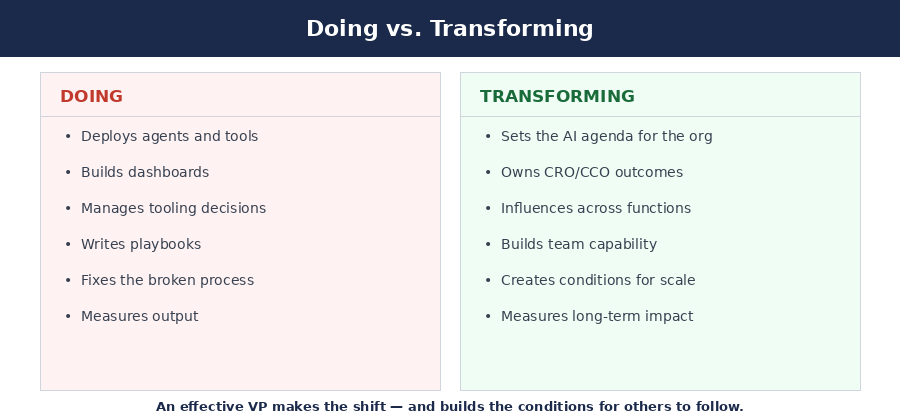
For ops leaders, this is especially acute. CS Ops and GTM Ops VPs who stay in doing mode spend their time deploying agents, building dashboards, managing tooling decisions, writing playbooks. Important work — but director work. The VP who stays here becomes a very expensive director. That’s the “overpaid and ineffective” problem.
The transformation looks different: you’re setting the operating model, owning the outcomes that matter to the CRO and CCO, deciding what the long-term effects of AI and automation should be on your org — not just which tools to ship. You’re not the one mapping the process. You’re the one making sure the right processes exist and are owned.
What a VP Actually Does
The list below isn’t a job description. It’s a picture of where attention has to go once you make the shift:
- Visionary Leader. Sets the future state and wins people to it — not by micromanaging but by making the direction clear enough that others can navigate toward it.
- Influence. VPs move the business through other teams, not just their own. If you can’t influence across functions, you’re a department head, not a VP.
- Strategic High-Level Thinker. When problems surface, the VP’s role is to reset toward the goal, not descend into the problem.
- Business Acumen. You need a real understanding of the business plan — not so you can execute it, but so you can critique it, refine it, and ensure your function is aligned to it.
- Sets the AI Agenda. In 2025 and beyond, a VP who is only deploying AI tools is still doing. The transforming work is deciding what the long-term effects of AI should be on the team, the function, and the customer experience.
- Owns KPIs. Own the metrics or they will own you. Effective VPs don’t just track numbers; they use them to make calls.
- Fosters Innovation and Execution. Encourage new approaches, build alignment, share wins. Create the environment, then let it run.
- Continuous Learner. The landscape keeps moving. Reading, attending, engaging — that’s part of the job now, not a luxury.
- Inspirational Leadership. What you do and how you show up gets magnified. Every ripple you create moves through the team.
- Empower Teams. Set vision. Encourage excellence. Get out of the way.
The Accelerator or the Decelerator
Great VPs have a high degree of self-awareness about their impact. The requests they make, the reactions they have, the priorities they signal — all of it shapes the rhythm of the business. A VP is either an accelerator or a decelerator. There’s no neutral.
The ones who stay in doing mode tend to decelerate without knowing it. They create bottlenecks. They underdevelop their teams. They make themselves the critical path for decisions that should be two levels below them.
The ones who make the shift create capacity everywhere. Their teams move faster. The organization trusts the function. And the VP has the attention bandwidth to actually think — which is the job.
If you’re a current or aspiring VP in GTM or CS Ops, the question worth sitting with isn’t “Am I working hard enough?” It’s: “Am I transforming, or am I just doing it faster?”


One response to “Being a VP: Moving from Doing to Transforming”
We’re in sync once again on what we are thinking about Jeff! I just finished some career progression mapping work where I did some definition of roles and scopes. I’ll shoot you an email with some more details. I’ll definitely look back at this as I build out more detailed descriptions on the senior roles.
LikeLike