Fresh eyes: help to see things anew.
Sometimes when we are so close to something, we cannot see it for what it is. Or we get so into the details that we can miss what’s important: what does CS Ops actually and and what are their responsibilities? We can’t see the forest from the tr—I mean, we can’t see the big picture because we’re swallowed by the details.
Without a framework, we’re apt to develop “shiny object syndrome” where our fascination with whatever is new or trending grabs our attention, pulls us down some rabbit hole, and we neglect the core objectives. “ooh, shiny!”
Whoops.
As an example, let’s bucket just a few that are common in Customer Success:
- Fiscal year planning
- Data quality/governance
- Establishing CS KPIs
Break out each of these into their parts, then assign the status (red, yellow, green), ownership (RACI model is good), and what is required to get to green.
Let’s go through these examples (shortened for brevity; they are non-exhaustive):
Fiscal year planning
- CSM roles and responsibilities to be re-defined and documented
- Coverage plan/territory plan is defined and agreed to
- Account assignment is complete
Data quality and governance
- Governance policy is established and documented
- Key data fields, inputs, and update policies used as sources for metrics and KPIs are documented, clear, and appropriately locked down
- Bug resolution processes are established and working as intended
Establishing CS KPIs
- Define top-tier CS KPIs (Net Retention, Gross Retention, Renewal Rate….)
- Document KPI definitions and calculations
- Ensure all source fields are trustworthy, reliable, and clear
Once defined, your responsibilities and path become clearer. Yes? Imagine distilling that into a slide to make it clear to leadership and your team where you stand, what is preventing you from completion, and what you need from them. People often want to help, they need to hear the request and what is needed. What if you could give them a slide like this?
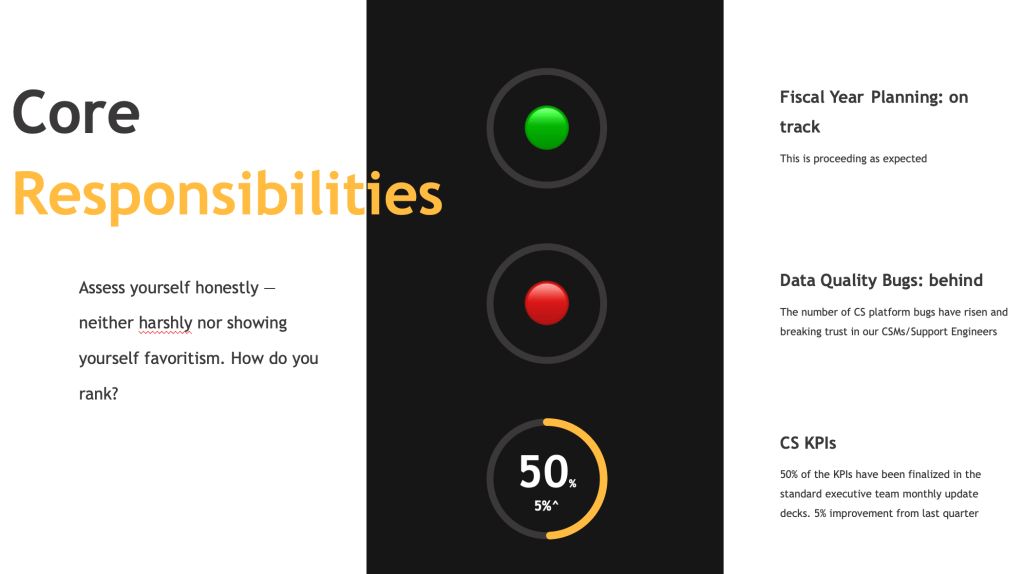
I’ve been asked, “A slide with three is great, but that’s not reality. How do you track it on a recurring basis? Where do you track it? How does it look and feel? How can I take what you’ve built and apply it in my role?” Here’s a mockup below (it’s fictitious) of what a spreadsheet could look like for a CS or Operations team.
A warning: it will be tempting to put in 30-50 things. Try to group them (e.g., “data quality management” should be an encompassing project). To avoid the risk of prioritizing everything (and thus, nothing), here’s a plan for you:
- List out all major projects
- Assign statuses and ownership for clarity
- Define what is required to get from bad (or okay) to great
- Define the top 3, 5, or 10 (more if you’re a larger, more established team with ownership spread across multiple individuals)
- Review your Core Responsibilities spreadsheet on a (weekly, bi-weekly, or monthly) basis to progress the reds and yellows. More frequent meetings are required if you’re in fiscal year planning or have a significant number of red statuses
- Take snapshots of where you start, and then at least monthly to track progress
- (This is often overlooked) Celebrate progress and accomplishments!

Thus, if you’re feeling overwhelmed and unable to see the forest from the trees, make sure you know what your (or your team’s) core responsibilities are. Identify, describe, assign the DRI (Directly Responsible Individual), and select the status (red/yellow/green). This won’t “fix” anything immediately, but it sure paints your path for you and brings clarity to what you must prioritize. Imagine having a rallying cry for your team. What if you and your team had that up in front and knew where to drive focus?
 Jeff Beaumont