Fresh eyes: help to see things anew.
Sometimes when we are so close to something, we cannot see it for what it is. Or we get so into the details that we can miss what’s important: what does CS Ops actually do and what are their responsibilities? We can’t see the forest from the tr—I mean, we can’t see the big picture because we’re swallowed by the details.
Without a framework, we’re apt to develop “shiny object syndrome” where our fascination with whatever is new or trending grabs our attention, pulls us down some rabbit hole, and we neglect the core objectives. “ooh, shiny!”
Whoops.
Start by bucketing your core CS Ops responsibilities. A few that are common across most teams:
- Fiscal year planning
- Data quality and governance
- Establishing CS KPIs
These aren’t projects. They’re domains. Each one contains multiple workstreams, each with its own owner, status, and path to completion.
Breaking It Down: From Domain to Workstream
Take each domain and decompose it into its component parts. Then assign three things to each component: a status (red, yellow, green), an owner (use the RACI model — Responsible, Accountable, Consulted, Informed), and what it would take to get to green.
Here’s what that looks like in practice, abbreviated:
Fiscal year planning
- CSM roles and responsibilities defined and documented
- Coverage plan and territory plan defined and agreed to
- Account assignment complete
Data quality and governance
- Governance policy established and documented
- Key data fields, inputs, and update policies used as sources for metrics and KPIs are documented, clear, and appropriately locked down
- Bug resolution processes established and working as intended
Establishing CS KPIs
- Top-tier CS KPIs defined (Net Retention, Gross Retention, Renewal Rate)
- KPI definitions and calculations documented
- Source fields verified as trustworthy, reliable, and clear
Once you’ve done this across your full responsibility set, something happens: the path forward becomes visible. You can see exactly where you are, what’s blocked, and what you need from others to move.
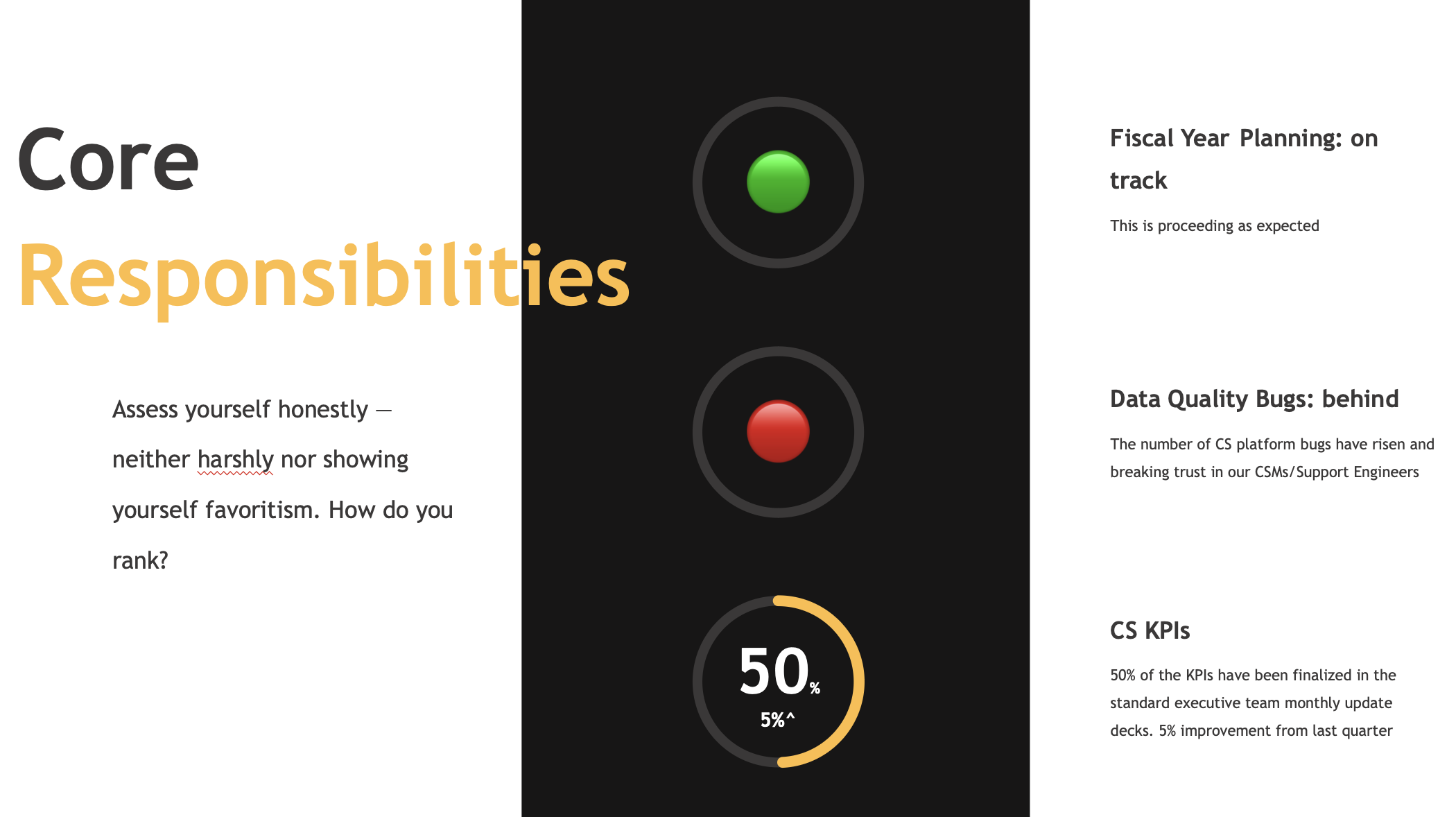
Imagine distilling that into a single slide for leadership — one that shows where you stand, what’s preventing completion, and what you need from them. People want to help. They need to hear the request clearly and know what’s needed.
Running It on a Recurring Basis
The question I hear most often: “A slide with three items is clean, but that’s not reality. How do you track this across a full responsibility set, on a recurring basis?”
Here’s the model. A few warnings before you start:
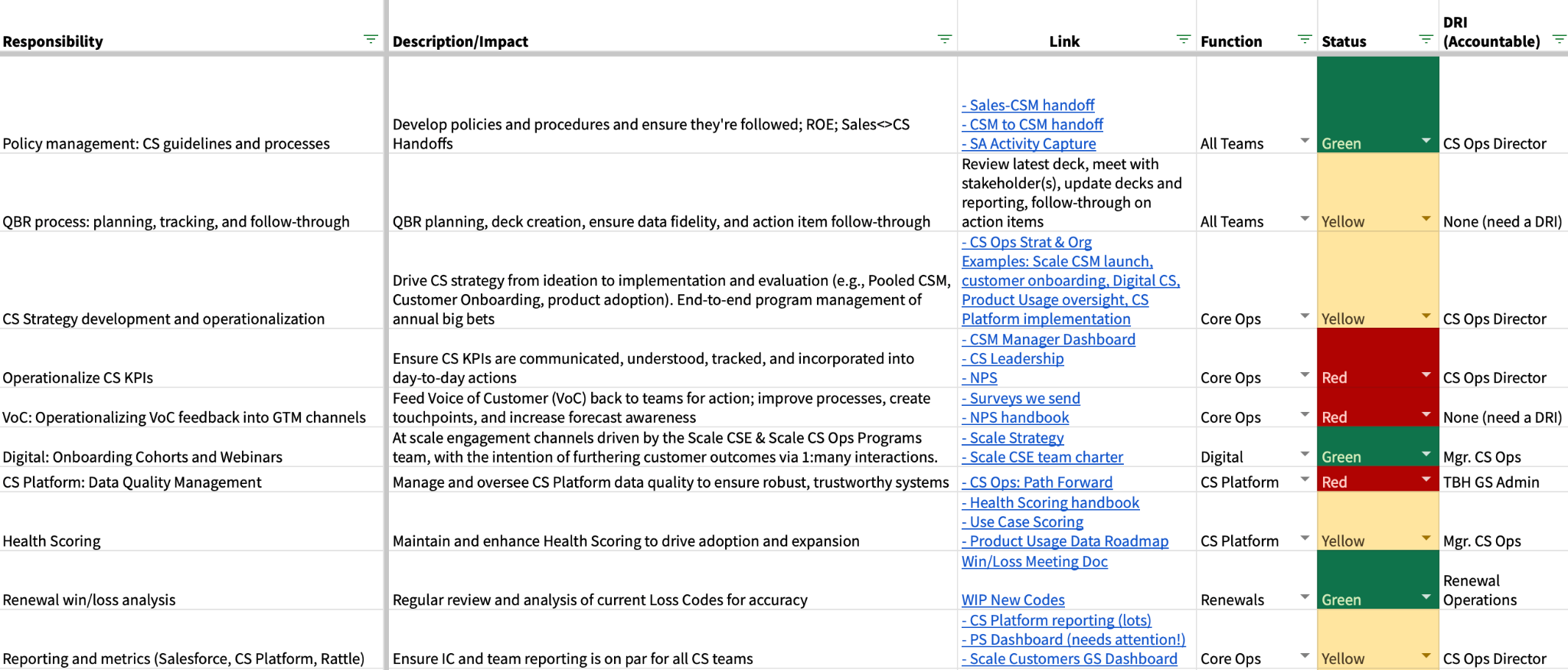
It will be tempting to list 30–50 items. Resist. Group them — “data quality management” should be an encompassing domain, not five separate line items. To avoid prioritizing everything and therefore nothing, follow this sequence:
- List all major responsibility domains
- Assign statuses and ownership for clarity
- Define what it takes to move from red or yellow to green
- Identify your top 3, 5, or 10 (more if you lead a larger team with ownership distributed across multiple people)
- Review on a weekly, bi-weekly, or monthly cadence to drive progress. More frequent if you’re in fiscal year planning or carrying a significant number of reds
- Take a snapshot at the start, then at least monthly to track progress
- Celebrate progress. This step is underrated and consistently skipped.
What This Actually Fixes
This framework doesn’t solve your problems immediately. What it does is paint your path. It tells you and your team where to drive focus, what you’re accountable for, and what you need from the rest of the organization to make progress.
If you’re feeling overwhelmed and unable to see the forest from the trees, start here. Identify your core responsibilities. Describe each one. Assign the DRI — the Directly Responsible Individual. Set the status (green/yellow/red).
Ownership ambiguity is where CS Ops dysfunction starts. Ownership clarity is where it ends.

