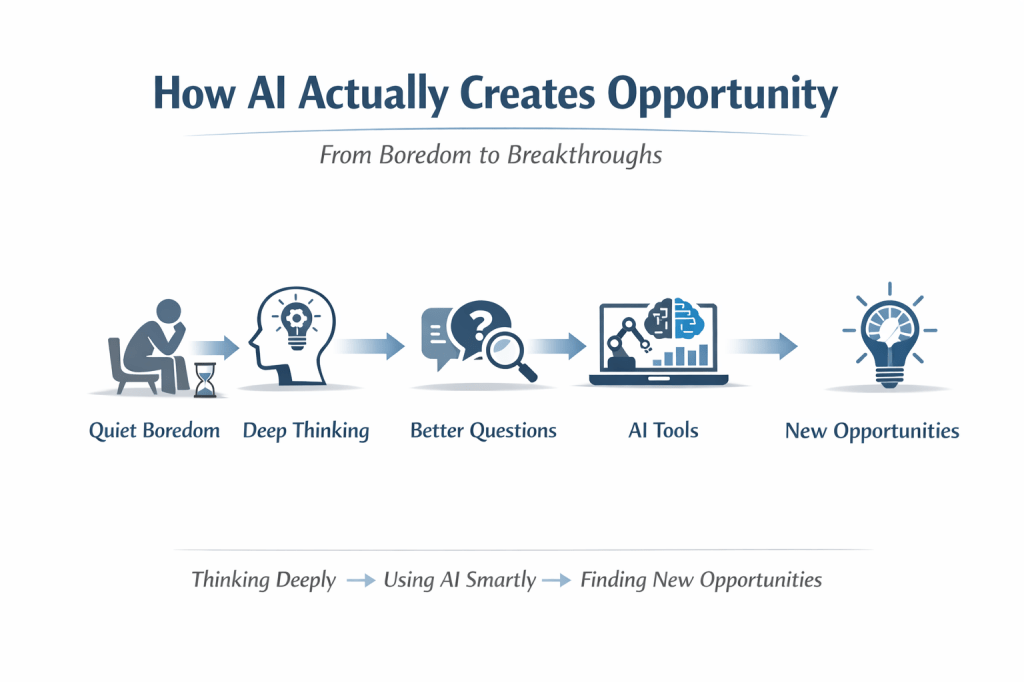
The more time I spend with AI, the more impressed I become.
Recently, it helped me write a preliminary report for an economic impact study and map several internal workflows to identify service level gaps. Also, I used AI to analyze a systemic drinking water shortage problem where I live in West Africa. I had never attempted these types of analyses before. AI didn’t just make the work faster—it made the work possible. Even still, I estimate that work might have taken me nine weeks on my own. With AI, it took a few days and was a significantly better, more compelling product. In a word, it felt like magic.
Most conversations about AI focus on efficiency or effectiveness. Efficiency means doing something faster. Effectiveness means doing something better. But I’ve become more interested in a third category: new opportunity. Two of the projects I mentioned above were not things I planned to do. In fact, they were well outside my normal responsibilities and abilities. AI didn’t just help me do them faster—it made them possible. This is a subtle but important shift. When tools lower the barrier to exploration, they expand the number of problems we can attempt to solve. However, there is a tension hiding beneath this opportunity. The same tool that expands thinking can also replace it.
The Importance of Boredom
One of the greatest sources of good thinking is something we fear: boredom. When bored, our minds wander. We question assumptions. We notice patterns. We connect ideas that normally remain separate. It’s much easier to swipe through notifications than stand for 15 seconds while pour our coffee. That is where many of the most valuable insights come from. Unfortunately, boredom is becoming rare.
Every quiet moment now has an escape ladder: a notification, a podcast, social media, email, or, increasingly, AI. Instead of sitting with a problem, we can instantly ask a machine to produce an answer. This is incredibly convenient. But convenience has trade-offs. If we outsource our thinking too quickly, we lose the mental friction that produces insight. We avoid the awkwardness. Deep thinking requires time. It requires silence. It often requires staring at a wall or a notebook longer than feels comfortable. That uncomfortable space is where real ideas tend to emerge.
Choosing the Hard Work
We claim we want to work on meaningful problems. No one wakes up and says: “I want to spend my day doing meaningless tasks that will be forgotten tomorrow.” But our behavior says otherwise. Small tasks give quick satisfaction. We check something off a list. We feel productive. The work is visible and immediate. The harder work — the work that actually matters — looks very different.
- A larger scope
- It may take weeks or months to complete
- Progress is often invisible
Thinking deeply about a complex problem is uncomfortable. It requires patience and discipline. It comes with a high risk of failure. What if I spent weeks on something and got nothing out of it? Also, it is hard work. It is like a workout. The mental muscles only grow when they are under strain. Too bad our fitness trackers don’t include a category for “thinking really hard.”
The Deeper Risk of AI
Many people worry that AI will replace jobs. That will happen in some cases. But there is a deeper risk. The real danger is outsourcing our thinking entirely. If we rely on AI to generate ideas, structure arguments, analyze problems, and make decisions, we slowly weaken the very skill that makes humans valuable: independent thought. Ironically, the more people outsource their thinking, the more valuable thinkers become. AI dramatically lowers the cost of producing average work, resulting in abundance of average work. And when something becomes prolific, its value declines.
Commoditization and Value
Consider the simple economic principle: when information becomes widely available, prices tend to fall. For example, in retail markets, sellers often profit through price asymmetry — buying goods at one price and selling them at a higher one. Information gaps make this possible. When information becomes easy to access, those gaps shrink. AI accelerates this process. If everyone can instantly research suppliers, compare prices, generate marketing copy, or analyze data, then many forms of low-thinking work become commodities. The work that remains valuable will not be the work that AI can easily replicate. See previous post on examples of data storage costs.
Instead, it will be the work that requires:
- Judgment and creativity
- Deep understanding and strategic thinking
- Interpersonal relationships
In other words, the scarce resource in an AI world will not be information. It will be people who know how to think well.
Set Yourself Apart
Many people make a living by moving information from one place to another. That model becomes fragile when machines can do the same thing instantly. The people most likely to thrive in an AI-driven world are different. They protect time for deep thinking. They ask better and contrarian questions. They explore new opportunities instead of optimizing old processes. They use AI as a power tool, not a brain substitute. In practical terms, this means deliberately creating space for boredom, curiosity, and reflection. Those moments feel unproductive. But they are the birthplace of the ideas that matter most.
A Different Lens
The conversation about AI often swings between extremes: some articles celebrate endless productivity hacks and others warn that AI will make us intellectually lazy. We could say “everything in moderation.” Or we could take on an entirely different view. AI can be an extraordinary tool for exploration and creativity. But like any powerful tool, it requires discipline. Instead, try to ask different questions. I occasionally take technology sabbaths — periods where I step away from devices entirely. It is a way of testing whether I am still capable of thinking clearly without digital assistance. In these moments I can ask myself, “are these the two logical extremes to consider?” or “What contrarian questions can I ponder about the philosophy and uses of AI?” In a smaller way, I treat AI like candy. A small amount can be delightful. Too much, too often, and it stops being healthy. I need to hear my own thoughts.
Final Thought
AI will not eliminate thinking. It will reveal who is still doing it. The people who cultivate curiosity, protect boredom, and wrestle with difficult ideas will discover new opportunities everywhere. Everyone else may simply move faster in the same direction and eventually become replaced.
 Jeff Beaumont