“You are building a case study here.”
My boss told me this early in my time at GitLab. I’ve turned it over many times since. On the surface it sounds like encouragement. Look closer and it’s a warning.
We didn’t hire you to run the playbook you ran somewhere else. We hired you because you can read this situation — this team, this market, this moment — and build something that actually fits. If we wanted a copy, we’d have bought one.
The Copy-Paste Failure Mode
Seasoned veterans do not artlessly replicate what has been, but they work together to fashion something new, under different circumstances and dynamics.
And yet the pull toward replication is strong. Most operators arriving in a new CS Ops or GTM Ops role do the same thing: audit the current state, identify gaps against a mental model from their last company, and start rebuilding toward that model. It’s efficient. It’s familiar. And it’s often wrong.
The previous company had a 200-person CS team, three product lines, and a mid-market motion. This one has 30 CSMs, one product, and an enterprise sales cycle. The coverage model, the QBR cadence, the health scoring logic, the renewal workflow — none of it transfers cleanly. But the operator has seen it work before, so they proceed with confidence.
The tells are recognizable: processes implemented before the current-state analysis is complete; frameworks adopted because they worked at the last company, not because they fit this one; velocity prioritized over diagnosis. The operator looks busy. Things get shipped. Problems that don’t match the template get ignored.
Replication vs. Translation
There’s a clean distinction worth naming: replication versus translation.
Replication moves the old model into the new environment. Translation takes what worked, understands why it worked, and rebuilds it for different conditions. The first is faster. The second is what you were actually hired to do.
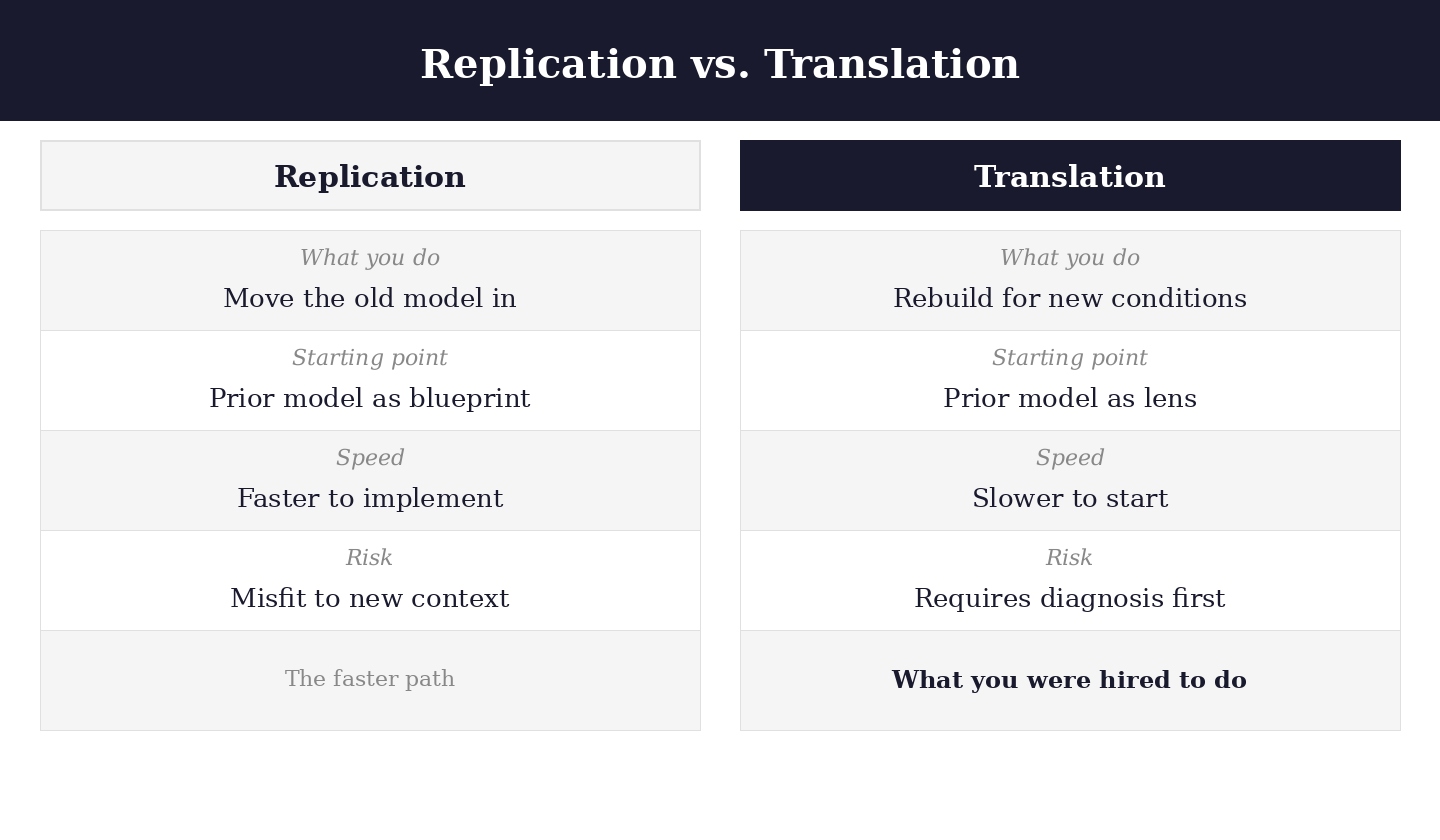
A chef who trained in France and opens a restaurant in California isn’t going to source the same ingredients or serve the same menu. The cuisine is French. The dishes are new. The skill is in knowing what transfers and what doesn’t — the technique, the ratios, the sequence — and rebuilding from there with what’s available. Many times a traditional crème brûlée suffices, and sometimes the entrée needs to change entirely. The wisdom is knowing which situation you’re in.
What Hiring Managers Are Actually Looking For
If you’re in a CS Ops or GTM Ops role and you’re job searching, this is worth thinking about directly.
Hiring managers at 200–500 person SaaS companies are not looking for someone who ran a successful ops motion at a similar company. They’re looking for someone who can walk into their specific situation — their stack, their team, their motion, their problems — and build something that works there.
The case study you’re building in your current role is the proof that you can do that. It’s not the result. It’s the evidence of judgment: how you diagnosed the situation, what you chose to preserve versus rebuild, where you moved fast and where you slowed down, what you’d do differently.
Your next hiring manager doesn’t want to hear what you built. They want to hear how you thought about what to build. Those are different things.
The Practical Version
Before you reach for any framework, process, or playbook from a prior role, answer four questions:
- What problem does this solve here, specifically? Not in general. Not in theory. At this company, with this team, at this stage.
- Why does this problem exist? Structural? Historical? Ownership gap? Capability gap? The diagnosis determines the fix.
- What have they already tried? There’s a reason the current state is what it is. Understand it before you change it.
- What would I need to learn before I’d be confident this is the right move? If the answer is nothing, slow down. You’re pattern-matching.
When building the case study, incorporate the past — the history, the successes and failures, and learnings — but don’t copy. Your future successes depend upon your past experiences, your team’s capabilities, and a compilation of ideas. An open mind and an outlook of creativity will help administer the past to solve the challenges of tomorrow.

